Anaheim Hills is a neighborhood of mature landscaping and hillside lots, and both of those things are working quietly against your sewer lateral. The canyon-side tracts have had fifty years for trees to put down root systems, and the lateral running from your house to the city connection passes straight through that soil.
Roots do not break into a healthy pipe. They find the places where it is already slightly open — and on a residential lateral, that means the joints.
Why Roots Always Find the Joints
A sewer lateral is not one continuous tube. It is a run of sections fitted together, and every fitted section has a joint. Clay pipe, cast iron and older PVC all share that trait.
Wastewater is warm and carries nutrients. Where a joint has shifted even slightly with soil movement, a small amount of vapor escapes, and roots grow toward it. What starts as a hair-thin thread thickens season after season until it forms a mat across the inside of the pipe. The pipe is not broken. It is occupied.
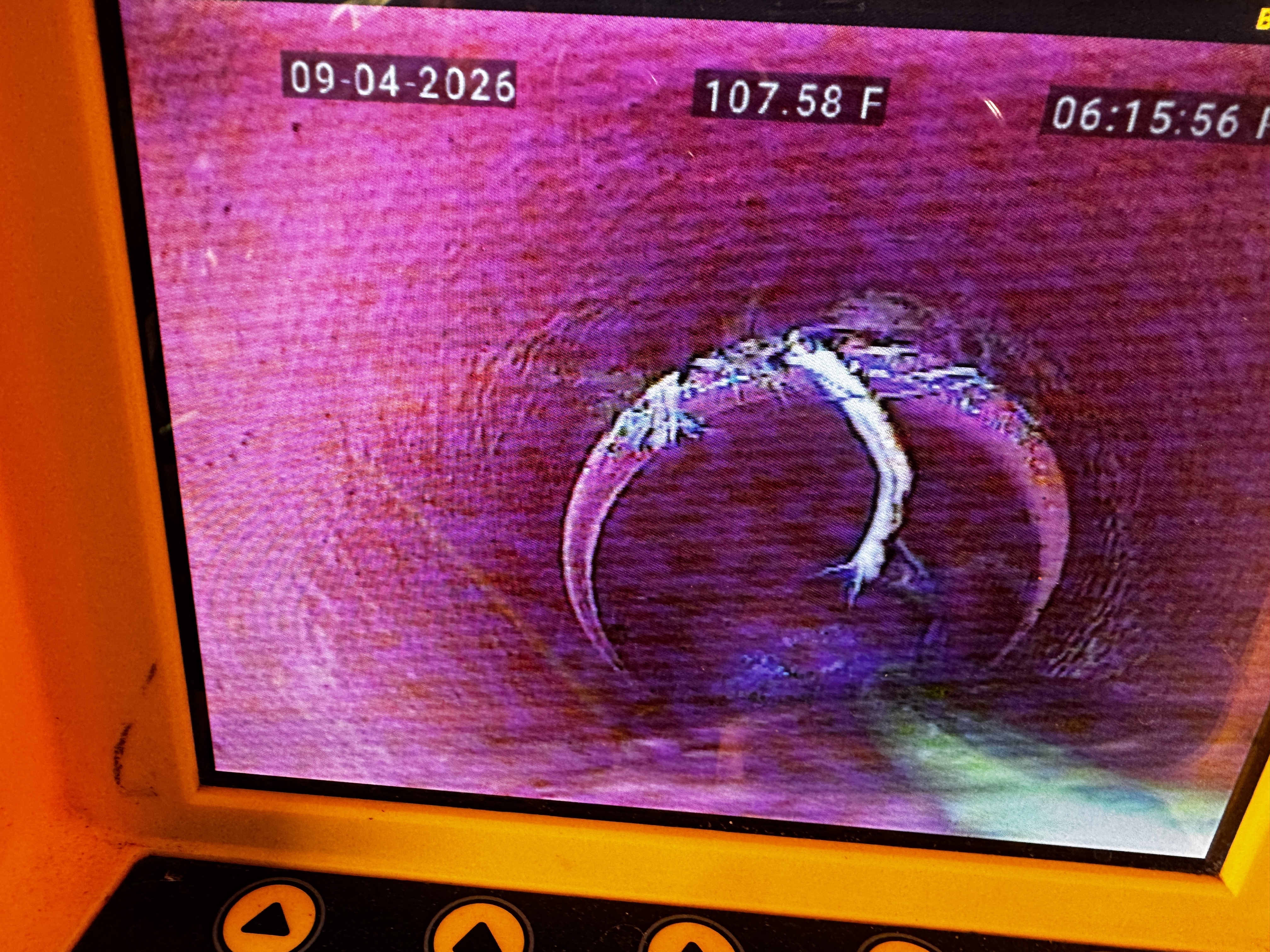
The photo above is a real finding from a recent scope. Moderate intrusion, at a joint, with the pipe still carrying flow. That is the stage where a homeowner has options. Left alone, roots do not hold steady; they thicken, they trap solids passing through, and a line that drains slowly becomes a line that stops.
What We Report, and What We Refuse to Report
You will notice the caption above gives a distance in feet of cable from the access point, not a depth below the surface. That is deliberate, and it is worth explaining because most companies do it the other way.
Cable distance is a measurement. It is counted off the reel as the camera travels, and it does not change. A depth figure comes from a locator reading the sonde in the camera head, and that reading fluctuates with soil, moisture and how the locator is held. Publish a depth and you have handed a contractor a number to argue with when the excavation comes up six inches different.
So we give you footage from the access point and a marked spot on the surface. Whoever does the digging can find it, and nobody spends an afternoon arguing about a figure that was never precise to begin with.
What a Scope Actually Involves
We locate the cleanout, usually at the side of the house, and feed the camera into the main lateral. You watch the live feed with us and we narrate as we go — pipe material, condition at each joint, anything intruding, any low spot holding water.
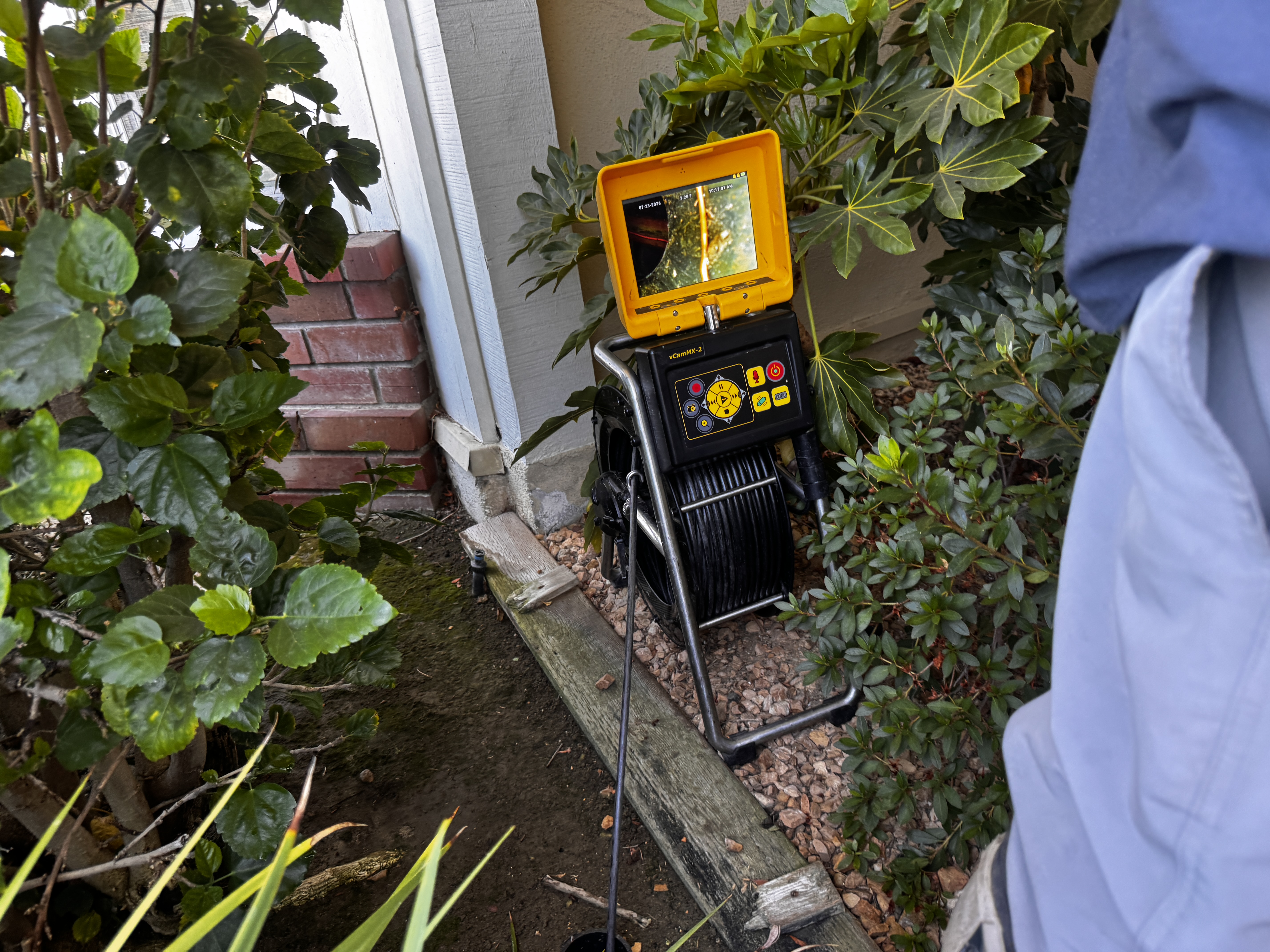
Most laterals take 20 to 40 minutes depending on length and access. You get a verbal summary on site before we pack up, and a written PDF report with the full video emailed the same day.
We do not sell you the repair. FlowPro OC runs the camera and writes the report. We do not perform the excavation, and we take no referral fee from the contractor who does. There is no version of a FlowPro report where we make more money by finding something worse than what is there.
When to Schedule One in Anaheim Hills
- You are in escrow on a home here — a general home inspection does not include the sewer lateral
- Drains are slowing, or clearing and then slowing again within a few months
- Toilets or drains gurgle when water runs elsewhere in the house
- There is an unexplained damp or unusually green patch in the yard or parkway
- The house is over thirty years old and the lateral has never been looked at
- There are large mature trees between the house and the street
That last one matters more here than in most of the county. Hillside lots and decades-old landscaping put substantial root systems directly over the line.
Serving Anaheim Hills and North Orange County
FlowPro OC works throughout North Orange County, including Anaheim Hills, Anaheim, Yorba Linda, Placentia, Brea and Fullerton.
Call 714-992-6363 to book a scope or to ask what a camera would tell you about your line. You will get a straight answer.
Book a Sewer Scope in Anaheim Hills
On-site walkthrough, same-day PDF report with the full video, and no repair quote attached.
714-992-6363 Call to Schedule